AR Campus Quest: An Interactive Onboarding Experience for University Freshmen
Role: UX/UI Design, Development
Motivation
University freshmen often struggle to understand campus buildings not because information is unavailable, but because it lacks context and emotional engagement. Traditional orientation materials present buildings as static facts, making them difficult to remember and easy to ignore.
This project started from the belief that people remember places better when those places are tied to stories and actions. By embedding campus information into a narrative-driven experience, we aimed to transform orientation from passive learning into meaningful exploration.
Goal
- Help freshmen build mental maps of campus spaces through contextual learning
- Increase engagement and memorability of campus information
- Reduce anxiety by reframing exploration as play rather than obligation
Methodology
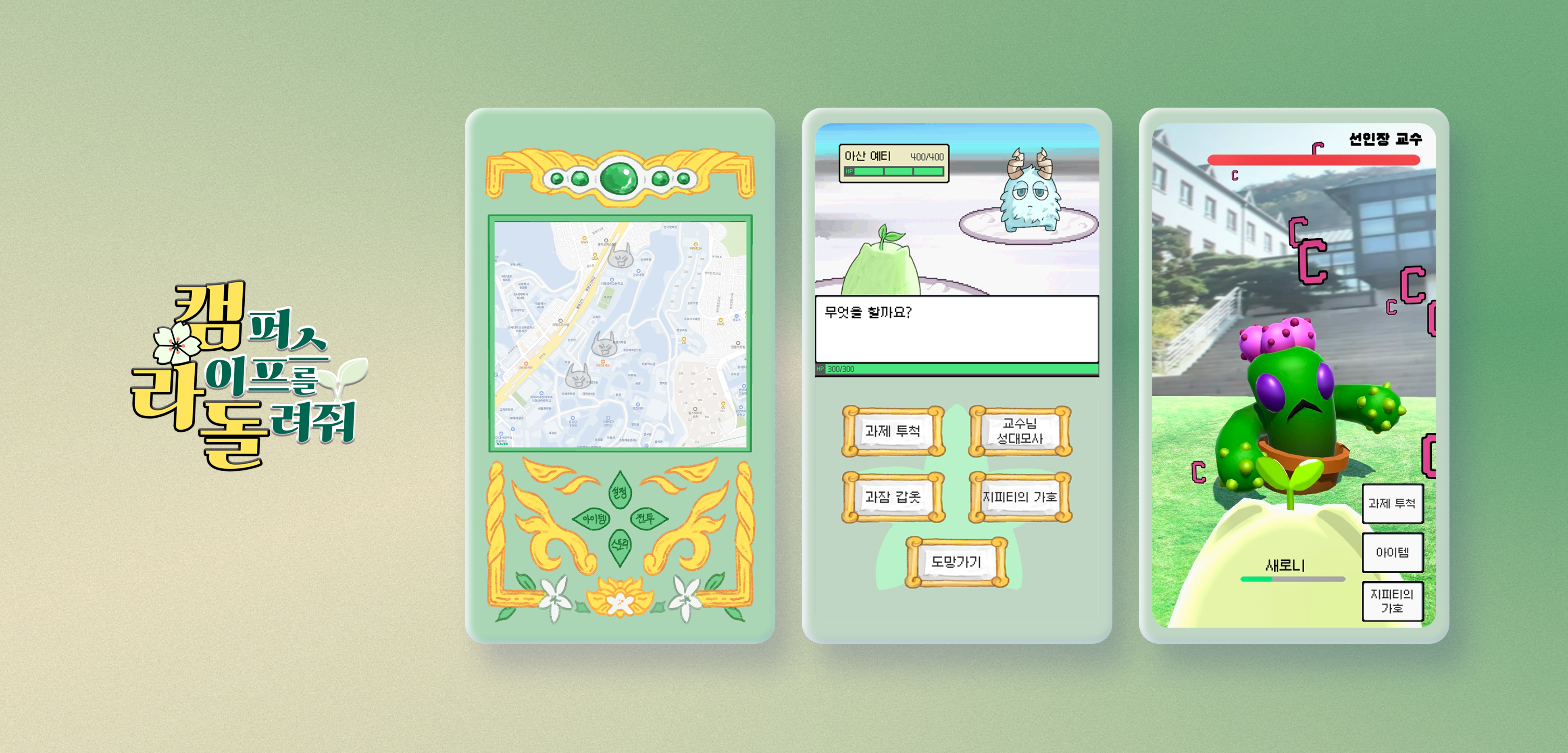
We designed and developed a mobile AR role-playing game where narrative progression drives spatial exploration.
Players follow a storyline in which stressed freshmen have transformed into monsters, and restoring campus life requires visiting real campus locations. Each building becomes a story node, where players unlock narrative scenes and tasks by physically entering the space and scanning AR markers.
The narrative structure serves as the primary interaction guide:
- It provides clear motivation for movement across campus
- It contextualizes why each building matters
- It creates emotional continuity that encourages completion
Game mechanics such as turn-based battles reinforce learning in a low-pressure environment, while boss encounters use full AR to create memorable moments tied to specific locations.
I designed the interaction flows and UI, and implemented the system using Unity 3D, mobile AR, and the Naver Map API.
Outcome
- Designed a narrative-driven onboarding experience that connects physical campus spaces with digital gameplay
- Demonstrated how storytelling can support spatial learning and sustained engagement
- Delivered a fully functional AR mobile prototype integrating design and development
- Showcased an alternative approach to orientation that prioritizes experience over information delivery
Reflection
This project reinforced my understanding of narrative as a UX probe, not just a storytelling element. The storyline functioned as a cognitive and emotional scaffold, helping users make sense of unfamiliar spaces through purpose and progression.
If extended further, I would:
- Test whether narrative-driven exploration improves recall compared to non-narrative onboarding
- Observe how story context affects motivation and movement patterns